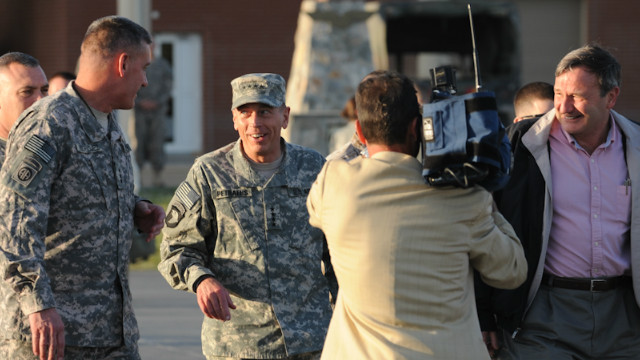
It's mind-boggling how quickly word gets out. I'm sure that's exactly what was running through General Patraeus's mind after the whole world learned about his short-lived affair. For those of you who are just finding out about the CIA scandal, I suggest you check out this link. When Jill Kelley reported threatening e-mails to an FBI agent, an affair between revered General David Patreaus and his biographer Paula Broadwell seeped out. But then, the situation became even stickier, when Kelley was accused of an affair with General John Allen, a close friend. Many details are still unclear, but there's one lingering question in the back of my mind. When a CIA director can't hide his activities online, can we really expect to?
 Most of us don't understand the intricacies of how information is spread through the web. E-mail, even when anonymous, is not as secure as you'd think. Each e-mail we send out carries little packets of information called "metadata", containing information about the source of an e-mail, such as an IP address. If someone is willing to put in the time, there's always a way to track information, no matter how you try to get around it. In fact, some reports claim that Petraeus tried communicating with Broadwell through saving drafts in a shared e-mail account. This may sound clever, however it probably made it easier for investigators to access the messages once they found out this method was being utilized.
Now, if you're one of those people who are thinking, "Well, I don't send private e-mails, so I don't have to worry," think again. Texts and phone call history can be tracked with the push of a button. When we take photos, digital cameras or image-storing programs often bundle data in an Exchangeable Image File Format (Exif) with each snapshot. This data may include GPS coordinates for where a photo was taken. For more information, read this article on digital privacy. I'm starting to wonder whether anything we do digitally can be considered "safe" from the people around us.
Only in the 21st century have we really seen digital footprints being used as criminal evidence. Ironically, an electronic communications privacy act was passed in 1986, largely before the age of the Internet and social media. But the USA PATRIOT Act, which Obama extended for an additional four years in 2011, expanded the government's definition of terrorism and its power of law enforcement, especially with regards to gathering intelligence.
 Yet, people are complaining about a lack of privacy even on a smaller scale, such as with social media. By clicking on certain links, you may be inadvertently yielding information to unknown websites. Most of the times, the information being sent out is harmless; for example, your search history, which could be beneficial to advertising companies. But there can be much greater implications; we've all heard a story of someone who foolishly sent their credit card, bank account, or social security number in an e-mail to a fraudulent address. Be careful, you are not as hidden in the digital world as you think.